| Artist |
Vuillard, Edouard |
OF ALL HIS WORKS, Edouard Vuillard’s small, poetic, dimly lit “intimiste” interior scenes dating from the 1890s are most coveted by collectors. The settings of many of these pictures are the various modest Parisian apartments that Vuillard shared
with his sisters and his mother—a widowed dressmaker and his lifelong muse. He often depicted Mme Vuillard at work, in the company of her assistants, unrolling bolts of material, cutting, and sewing, amidst a profusion of subtly hued, patterned wallpapers, screens, curtains, tablecloths, and clothing.
The artist’s closest Nabi confréres, Pierre Bonnard (1867-1947) and Ker-Xavier Roussel (1867-1944), and his friend the theater enthusiast Aurélien Lugné-Poé (1869-1940), frequently stopped by the Vuillards’ for a visit, and he painted them in the same interiors as they lingered after a meal.
Vuillard’s second muse during the 1890s—he never married—was Misia Natanson (née Godebska; 1872-1950), the Polish wife of Thadée Natanson (1876-1951). Thadée, together with his two brothers, Alexandre and Alfred, had founded the art journal La Revue Blanche (1891-1903), which was devoted to the best in contemporary music, literature, and art. Misia, the daughter ofa lesser-known sculptor and the granddaughter of arenowned cellist, was high-spirited, intelligent, witty, independent, and beautiful. Her talents as a pianist had impressed the aged Franz Liszt, as well as her teacher, Gabriel Fauré.
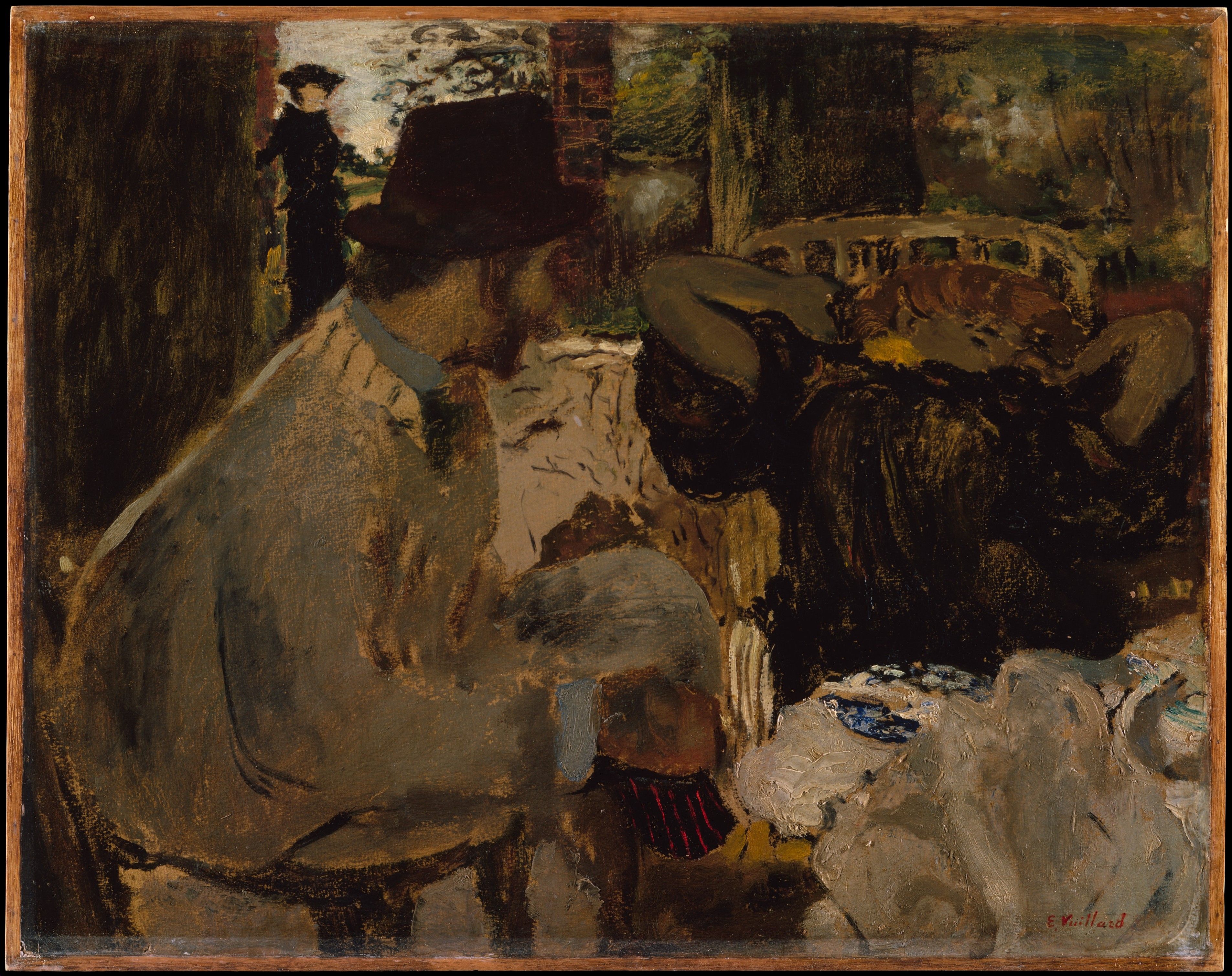
In her apartment in the rue St-Florentin in Paris (which also was known as the “annexe” of the offices of La Revue Blanche), she entertained and charmed writers, poets, and painters. Henri de Toulouse- Lautrec, Pierre Bonnard, Pierre-Auguste Renoir, and Félix Vallotton all made paintings of Misia,' usually representing her listening to music or at the piano, in luxurious interiors to which her presence adds a languid sensuality. However, no artist painted Misia as often as Vuillard, either in her Parisian apartment, or—as here—at her country house. (After he designed a frontispiece for La Revue Blanche in 1894, Vuillard became an intimate of the Natansons.)
By choosing a shaded grove surrounded by dark tree trunks as the setting, Vuillard gave this outdoor scene the look of an interior. Misia, at the right, wears a black dress with floppy sleeves and leans back dozing in her chair. The mysterious figure of a woman, hovering in the distance at the left and also in black, is amotif often found in the artist’s interior views, seen either entering a room or peering through an open door.
Inscription: Signed (lower right): E. Vuillard
Accession Number: 1999.363.85
Provenance:
the artist (until d. 1940); his nephew, Jacques Roussel, Paris (from 1940; sold to Renou et Colle); [Galerie Renou et Colle, Paris; sold ca. 1950 to Mayor?]; [Mayor Gallery, London]?; [Sam Salz, New York, until 1951; sold on February 9, 1951 to Gelman]; Jacques and Natasha Gelman, Mexico City and New York (1951–his d. 1986); Natasha Gelman, Mexico City and New York (1986–d. 1998; her bequest to MMA) |