| Artist |
Vuillard, Edouard |
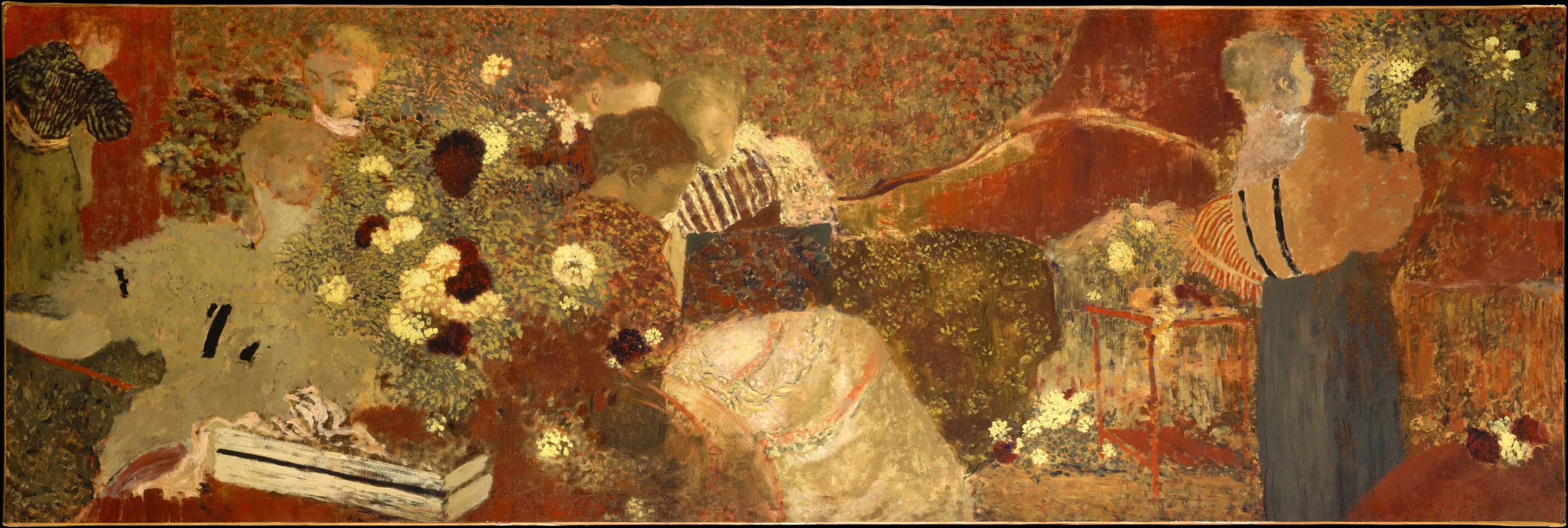
In the center, a group of three women on a canapé examine an open album. Another woman, on the right, arranges flowers; two others group themselves on the left; the seventh is situated at the edge near the frame. It is appropriate for this painting, and the others with which it forms an ensemble (five in total), to make an observation that applies, no less than before, to all the works of this artist and the best of his contemporaries—namely, that the design, or rather the definition of the objects, possesses in the paintings only the plastic value of an arabesque. The pleasure of naming these objects undoubtedly intervenes in that which is given by the images, but this is hardly the point. Its real essence is abstract. The general effect is of red and green enlivened with yellow. These are basically woven together in the background in narrow, juxtaposed strokes, yet they emanate throughout the picture with the subtlest of variations, the reds descending sometimes almost to browns and blacks, at other moments lifting to vermilion and tones of rose. The yellow is sometimes muted nearly to beige. The color at times is divided into small, isolated touches; in other passages it is gathered into delicately modulated masses. The contrast between those two processes is brought to its height at the center.
This evocative and loving description of The Album was given by its owner, Thadée Natanson, in 1908, when he was forced to sell it, along with much of his collection. (The sale contained twenty other works by the painter, as well as splendid examples of Delacroix, Cézanne, Seurat, K.-X. Roussel, and Bonnard.) Few people were better suited to address the subtly intimate yet grandly realized achievement of Vuillard. Since 1891 Natanson had been the editor and publisher, with his two brothers, of the progressive and lively Parisian journal La Revue Blanche. Along with music criticism by Claude Debussy and sports by Léon Blum, it had frequent contributions from Stéphane Mallarmé and the young André Gide. For eleven years La Revue Blanche was, as John Russell has noted, simply “the best periodical of its kind that has ever been published.”
Many of the artists who designed its frontispieces—Vuillard and Bonnard among them—formed an alliance. When they first showed together in the shop of Le Barc de Boutteville in 1891, they called themselves the Nabis, from the Hebrew word for prophet, at the suggestion of one of their members, Paul Sérusier. In contrast to the Impressionists some two decades earlier, much of their formulation was theoretical, based on the premise that visual reality is only a beginning for art, which then, through poetic, symbolic, and formal processes, would lead to more general and profound revelations. Gauguin, with whom Sérusier studied at Pont-Aven, was their central hero. The evocative and finely wrought poetry of Mallarmé and the seamless music of Debussy are often recognized as their nonvisual equivalents.
Some, such as Maurice Denis, who eventually gave himself over completely to criticism, or Henri Ibels (see p. 62), who never quite left the world of illustrated journalism, soon wandered from the initial premise of the group. Others—most importantly Bonnard and Vuillard—were nurtured by the liberating theories of the Nabis and pursued a new goal: to create art that was suggestive rather than declarative, sensuous rather than descriptive, and, perhaps most importantly, decorative in the sense of harmonious unification and continuous rather than objectively illusionistic. It is in the true spirit of these intentions that Natanson described Vuillard’s pictures.
One of the central tenets of the Nabis—albeit a principle not followed consistently by any of their members—was the abandonment of the conventional paintings so firmly linked with the Parisian bourgeois collectors who had provided the first audience for the Impressionists. The young critic Albert Aurier, chief spokesman for the Nabis, stated in 1891: “Painting can only have been created to decorate with thoughts, dreams and ideas the blank walls of human buildings.”
The easel picture is nothing but an illogical refinement invented to satisfy the fancy of the commercial spirit of decadent civilizations.” The Dutch Nabi painter Jan Verkade (1868–1946) recalled that a war cry went up in the early 1890s: “No more easel pictures! Away with useless bits of furniture! Painting must not usurp a freedom which cuts it off from the other arts! The painter’s work begins where the architect decides that his work is finished! . . . There are no such things as pictures, there is only decoration.” And if the Nabis regretted that Gauguin was rarely allowed the opportunity to work on a large decorative scale, the grand public murals of Puvis de Chavannes (1824–1898) were there to lead them.
Of course, the abandonment of easel painting was not an absolute principle for Vuillard, who, unlike many of his Nabi colleagues, avoided generalized theories and formulations; many of his most beautiful works in the 1890s were remarkably fine, small panels (fig. 164). Yet, starting in the early nineties with the stage flats he executed for his schoolfellow friend Aurélien Lugné-Poe, he began working on a large decorative scale that would bring Aurier’s theoretical postulations to an enchantingly seductive reality in a series of closely interconnected private commissions. The first commission came from a cousin of the Natansons, Desmarais, in 1892, for six long horizontals and a folding screen to decorate his study. The themes, as they nearly always would be for Vuillard, were drawn from the gentlest and most untroubled of domestic genres—women gardening, children playing with a dog, a dressmaker’s shop like the one run by Vuillard’s mother.
Following the success of these, Thadée Natanson’s older brother Alexandre requested a more ambitious series of nine large, upright panels depicting children and nursemaids in the public gardens of Paris (fig. 165). Although they were in their original positions for a short time, these two series, like those done later in the 1890s for Claude Anet and Dr. Vasquez, seem to have been carefully calculated to make a complete decorative scheme. It is this quality that Paul Signac noted in 1898: “What is especially noteworthy about these two panels is the clever way in which they fit into the decoration of the room. The painter took his key from the dominant colors of the furniture and the draperies, repeating them in his canvases and harmonizing them with their complementaries. Truly, these panels do not look like paintings: it is as if all the colors of the material and carpets had been concentrated here, in the corner of this wall, and been resolved into handsome shapes and perfect rhythms. From that viewpoint the work is absolutely successful, and it is the first time that I have received this impression from a modern interior.”
The works commissioned by Thadée seem to have been more loosely considered in this sense, as unified as they are in color and composition. Three, including The Album, are extended horizontals, one a large vertical (fig. 166), and the fifth, a rectangle of an easel scale (fig. 167). Although it is difficult to speculate on their original arrangement, all have one dimension in common. Vuillard himself confirmed the unity of the five apart from all the other works done by him for the Natansons: in a personal chronology he drew up after the turn of the century, he simply noted in the listings for 1895: “The panels done for Thadée; December.”
The Natansons’ apartment on the rue Florentin, just off the place de la Concorde, was one of Vuillard’s favorite haunts throughout the nineties. Thadée’s wife, the high-spirited Misia Godebska, was, after his mother, the central figure in his life, their relationship summarized as allowing “the security and assurance of a perfect understanding.” Many of his most enchanting small paintings of this period document the richly patterned interiors of their apartment (fig. 168)—nearly always shown at night with the large rooms pooled with light from heavily shaded lamps. One of the 1895 series, Conversation (Pot de grès), appears in the background of his Misia, Vallotton, and Thadée Natanson (fig. 169). Another, Embroidering by the Window (fig. 166), appears in an undated photograph of Misia, and, like Conversation, it is seemingly unframed (or surrounded with simple molding) and placed on a strongly patterned wallpaper. The Album appears behind Misia in the Karlsruhe interior of c. 1897 (fig. 170); she is shown playing the piano while her brother, the comic Cipa Godebska, listens intently. But clearly the placement of this work was hardly sacred, since it reappears in a photograph of a billiard room with Thadée and his sister-in-law Ida Godebska (fig. 14).
It is therefore difficult to speak of these five works precisely as a decorative series in comparison with others; yet it is because of Thadée’s own description of them as an “ensemble” that we must acknowledge Vuillard’s careful consideration of them as a harmonious pictorial unit. They also share a sustained evenness of psychological unity: young women in striped blouses setting about their leisurely, civilized tasks within richly textured interiors, with the continuous presence of flowers—all of them autumnal chrysanthemums—in a tonality underscoring the essential palette of all five works.
Everything is subdued and peaceful. The elegant full-bosomed women—all perhaps variants of his friend and patron, Misia—are literally fused in the most serene way with their surroundings. Their charming, patterned day dresses, observed in chic understatement with the attention one would expect from a dressmaker’s son, play counterpoint to the room and its objects: the plane of the printed mutton-chop blouse of the central figure in profile is juxtaposed with the marbleized cover of the album; the suspenders of the figure arranging flowers on the right wittily play off the striped red fabric of the overstuffed chair beyond. The women exist, as do all the other women in the series, in a slightly hermetic world of domestic ease and leisure that echoes seventeenth-century Dutch genre pictures, the light seeming at first to come from some unknown source near the center and then to be suffused throughout the whole composition.
But if the light is that quality of still radiance so loved in Vermeer’s pictures and extolled by Vuillard’s friend Marcel Proust, it falls within a space that has been translated through the interiors of Degas. The space is completely lucid, yet all calculation is subtly held in check. Just when gatherings of color would seem to nearly turn geometric clarification into pure pattern, Vuillard introduced in perspective the precisely defined little mahogany (or red Chinese lacquer) table and the long cardboard box, its ribbons suggesting a florist’s delivery, providing some small narrative outside our reading. However, in contrast to earlier multifigure interiors such as The Suitor of 1893 (Smith College Museum of Art, Northampton, Mass.), which is given a cerebral quality by its mathematical calculation of a complex arrangement of foreshortened planes, upright panels, and a subtle interweaving of oblique angles, in The Album there is just enough spatial elucidation to rest serenely in balance with the sensuous interplay of two-dimensional pattern. When Vuillard takes up the theme later in the decade, in the 1897 Large Interior with Six Figures (Kunsthaus, Zurich), his pleasure in the tapestrylike surface has receded into a more literal and descriptive mode, not only explaining the space of the room more specifically but also reintroducing the quality of nearly theatrical interplay between his characters, which seems absent in The Album.
And yet, is The Album—or the series of five pictures—completely without narrative implication? Much of Vuillard’s great power to seduce is in his ability to mysteriously suggest a glimpse, a moment, that we only half understand. The seven women partake in shared pleasures in a completely sisterly manner. The sense of their gentle apartness in a rich bourgeois interior, very like the Natansons’ rooms where these pictures would hang, suggests a modern reference to the seven vestal virgins, those wise Roman women representing domestic virtues and the value of isolated perspective, who appear throughout seventeenth-century French paintings.
Vuillard would, of course, be too elusive and too independent of mind to force any historical (or, for that matter, contemporary) reference. Yet his life in the 1890s was a balanced routine of picture looking, visits to the theater, and attendance at soirées (particularly at the Thadée Natansons, where he was famous for his nearly mute good manners but always stayed to the end), which constituted, at least in part, the creative ingredients for a picture as subtle and implicative as this. Things he witnessed—either saw or sensed—were filtered through his memory and imagination. For his close and intimate friends Thadée and Misia, he produced a series of pictures that are at once completely of their time in the fashion of the clothes and the decor, yet quite out of time in a mood of domestic calm.
The complete ease with which he approached his subject is no better evidenced than by the means with which he painted it, and, as Thadée himself noted, the real subject is just this. The Album is executed in a complex weave of light brushstrokes with very little buildup of paint (except in the faces), no color overlapping another. A buff ground seems to have been scraped away in silhouetted patterns, most obviously in the large bouquet to the left, over which The pigments are laid without underpainting or modulated tones, almost as if applied with a stencil to accommodate each color variant. At times these surfaces, which follow the described object only in a general way, have the quality of inspired accident—the easing of a figure into an overall network of patterns—that is so admired in Japanese glazed ceramics. Sensuously rich lines appear—the long wet stroke defining the top of the arch-backed sofa, for example—like comets in a starry firmament, clear but almost immediately subsumed by the pattern of the whole. No one element—line or pattern, dark or light, recessive or aggressive color—outweighs any other.
Inscription: Signed (lower left): E. Vuillard
Object Number: 2000.93.2
Provenance: Thadée Natanson and his wife, née Misia Godebska (1895–1904; one of five decorative canvases, known collectively as The Album, commissioned in 1894–95, completed November 1895, and installed in their Paris apartment in or after January 1896; later installed in their summer residence Le Relais, Villeneuve-sur-Yonne, and possibly at La Grangette, Valvins, near Fontainebleau); Thadée Natanson (1904–8; his sale, Hôtel Drouot, Paris, June 13, 1908, no. 51, for Fr 2,000 to Rysselberghe); Théo van Rysselberghe, Paris, later Saint-Clair, Lavandou (from 1908; d. 1926); Émile Mayrisch, Colpach, Luxembourg (d. 1928); his daughter, Mme Pierre Viénot, called Andrée Pierre-Viénot (by 1928–69; sold on February 18, 1969 to Wildenstein); [Wildenstein, New York, 1969–72; sold on April 11, 1972 to Annenberg]; Walter H. and Leonore Annenberg, Rancho Mirage, California (1972–2000; jointly with MMA, 2000–his d. 2002; his bequest to MMA)
|