| Artist |
Jean Frédéric Bazille |
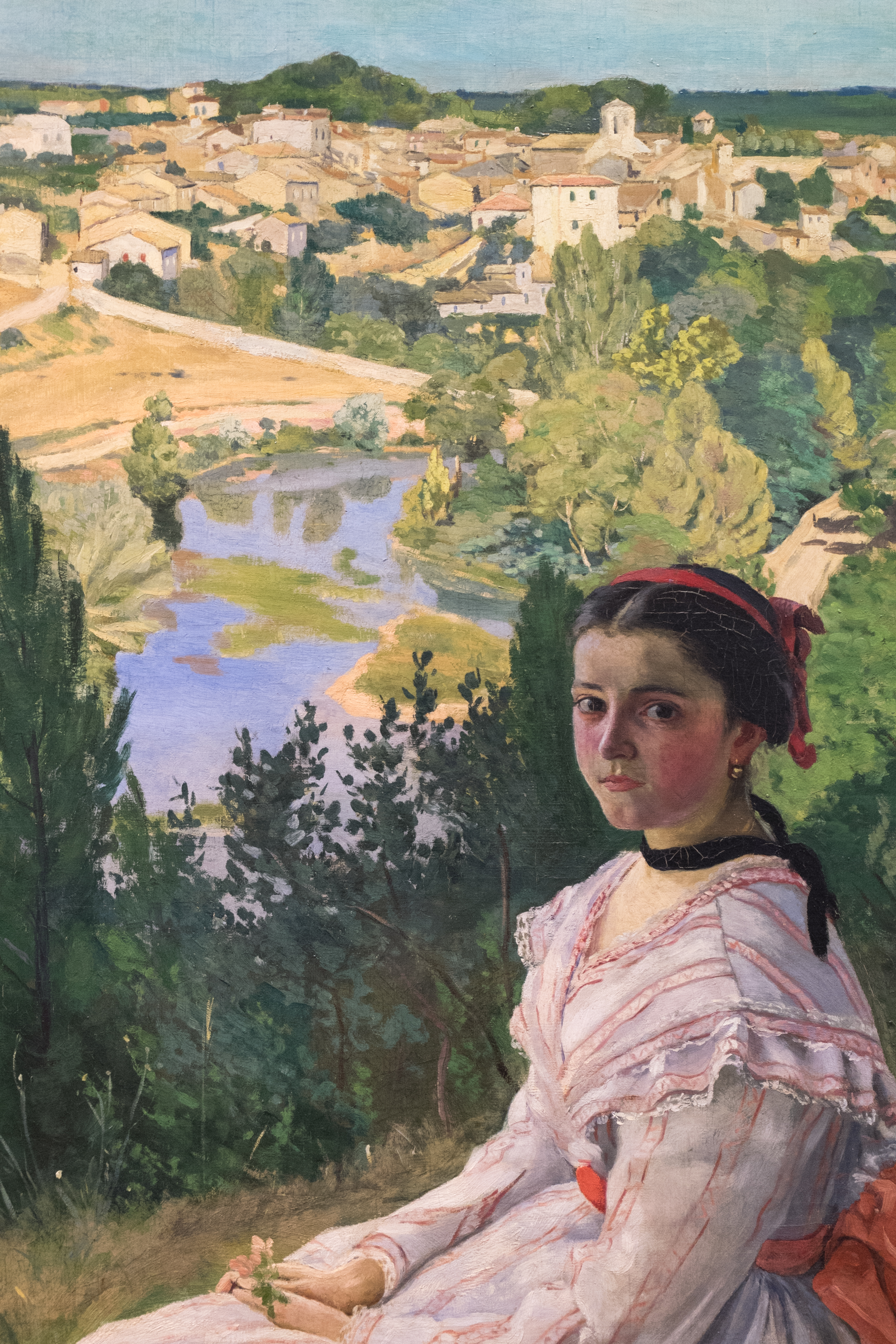
When La Vue du village was accepted for the 1869 Salon, Alfred Stevens, Bazille’s only friend on the jury, was quick to write with the news. “My dear Bazille, your painting, La Femme, has been accepted; I am glad to give you this good news. You were defended (between us) by Bonnat, and guess who else? By Cabanel!”¹ (Le Pêcheur à l’épervier [cat. 10] had been rejected.) As soon as Berthe Morisot saw the painting she informed her sister, “The tall Bazille has painted something that I find very good. It is a little girl in a light dress seated in the shade of a tree, with a glimpse of a village in the background. There is much light and sun in it. He has tried to do what we have so often attempted—a figure in the outdoor light—and this time he seems to have been successful.” Puvis de Chavannes, now quite friendly with Morisot, also admired the painting. “I received some very flattering compliments, among them one from M. Puvis de Chavannes.”
For this admirable work Bazille took the composition of his first important figure painting, La Robe rose (The pink dress, 1864; Musée d’Orsay, Paris), reversed it, and turned the figure toward the viewer. Once again the village of Castelnau appears in all of its meridional beauty. The daughter of the family gardener posed for him in the summer of 1868. Although contemporaneous critics and modern ones too have found fault with the perspective,⁴ Bazille quite clearly extended the visual field by looking down on his model and then looking up and out toward the far distance in order to make more of the landscape visible. In this respect he followed Monet’s procedure in Le Jardin de l’Infante (cat. 133). As in the majority of his plein air scenes, he placed the foreground figure in shadow, but here there is sufficient light to model the young woman in the round.
Curiously, Bazille’s picture was ignored by the Parisian press. Castagnary, for example, had cited Portraits de la famille (Portraits of the Family; Musée Fabre, Montpellier) as “a painting I would not call good, but interesting in all aspects.”⁵ But he did not mention Vue du village in 1869. Only J. Ixe, the disagreeable critic from Montpellier, felt obliged to consider the painting at length. “I like that very much. Certainly, it is original and new, very new . . . perhaps by dint of its reversion to the primitive painting of the Middle Ages as revived in the work of M. Puvis de Chavannes.
“A young lady dressed in white and hatless is seated in the shade on a knoll, at the very bottom of the painting. She looks at you with an expression all the more vacuous because it scarcely accounts for a nuance of shy uneasiness. Could she be afraid of having to show her hands, which, poor girl, are too small and so badly painted? Above her head, in dazzling sunlight, there rises almost to the top of the canvas the cavalier panorama of a landscape with river, village (Castelnau, I believe), vegetation and hills. One hesitates at first between qualifying the work as eccentric or as naive. In the end, one must recognize that all the boldness of composition and color is absolutely true. The perspective, above all, particularly difficult, is as exact as seen through the lens of a camera lucida or in a photograph. The color and effect, except a few greens that would make Corot faint, equally impose themselves by their healthy sincerity. If M. Bazille can combine these instinctive qualities with a personal line of conduct, independent of the government . . . you will soon see Manet take good advantage of it.”
Signed and dated lower center: F. Bazille 1868.
Inventory number:
898.5.1
Provenance:
The artist’s parents, Gaston (1819–1894) and Camille Vialars (1821–1908) Bazille, Montpellier; Mme Bazille’s gift to the museum, 1898 |